

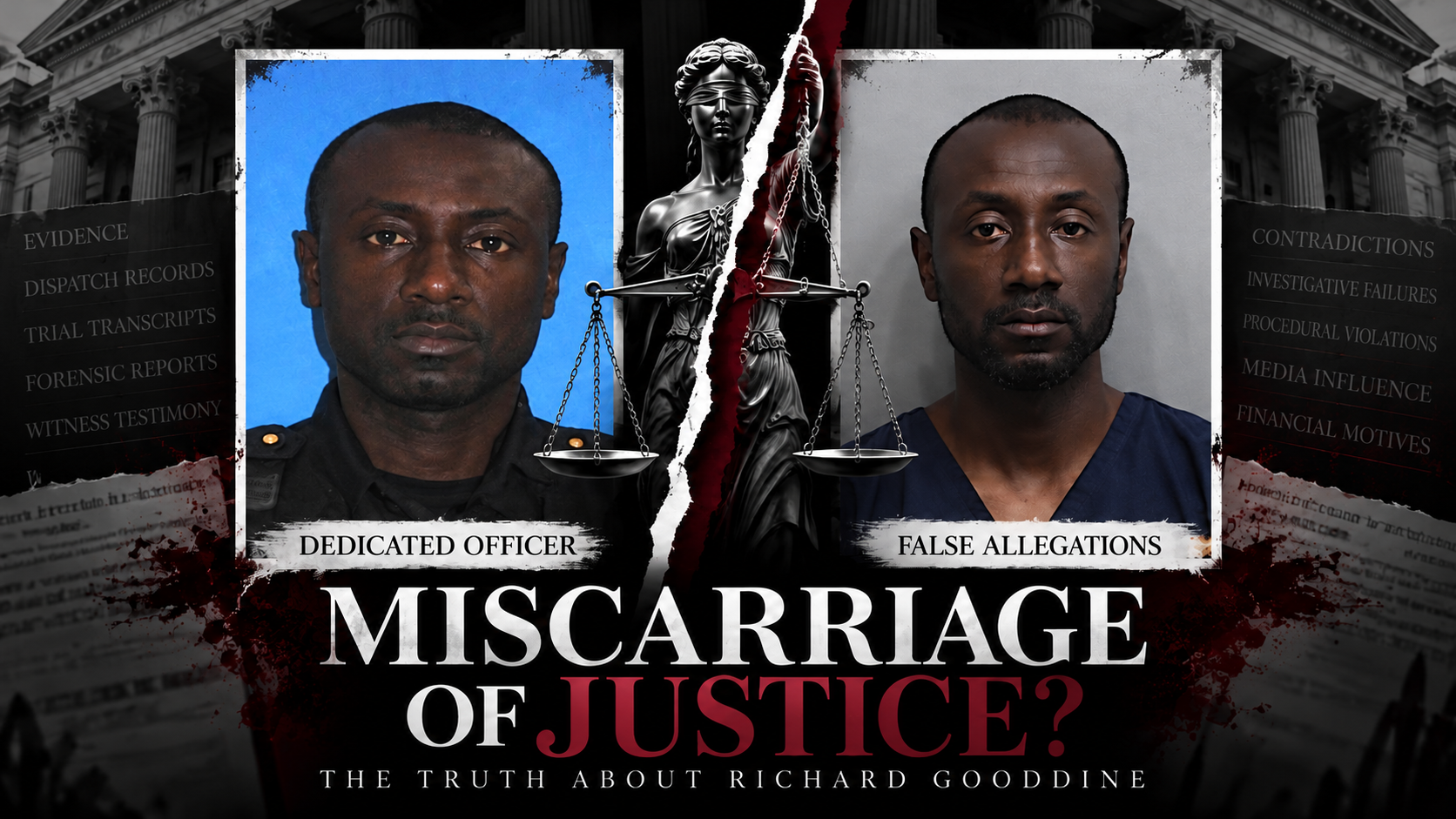
This website is not intended to belittle, minimize, or dismiss the seriousness of sexual assault. Sexual violence is a real and devastating problem in our society, and genuine victims deserve to be heard, protected, and treated with dignity.
However, we also recognize that the justice system can be manipulated for personal interests, financial gain, or other motives. When accusations are accepted without thoroughly examining contradictory evidence, the consequences can be devastating—not only for the accused but also for the credibility of the justice system and the genuine victims who depend on it.
We believe his case demonstrates the dangers of institutional bias, premature judgment, and the potential exploitation of serious allegations for personal or financial benefit. We believe these failures contributed to the loss of his career, reputation, freedom, and fundamental legal protections.
Our purpose is not to silence victims. It is to ensure that accusations are examined with the same seriousness as the evidence, that no person is convicted because of public pressure or assumptions, and that no institution places protecting a narrative above discovering the truth.
Supporting victims of sexual assault and defending the rights of the wrongfully accused are not opposing principles. Both are essential to justice.
A life destroyed

From a Innocent Redirect to a Life Destroyed: The Roles of Kayla Bell, Thomas Reynolds, and the Adults Behind the Allegations
What began as a innocent late-night encounter involving a minor, two adult male companions, alcohol, and a BB gun ultimately became a criminal prosecution that cost a dedicated police officer his career, reputation, and freedom. We believe the truth about how these allegations developed has never received the scrutiny it deserves.
Contaminating this I RoxanneOn August 20, 2018, Richard Gooddine encountered a group of young people at Sykes Park in East Point, Georgia. Among them was a 15-year-old girl who was out late at night without a parent or guardian present. Alcohol and a BB gun were discovered during the police encounter.
These circumstances raised legitimate concerns about adult supervision, parental awareness, and the safety of a minor. Yet as the allegations against Gooddine developed, attention shifted almost entirely toward the officer, while the decisions and influence of the adults surrounding the young complainant received far less public scrutiny.
The Role of Kayla Bell: Family Influence and the Development of the Allegations
Kayla Bell, the complainant's older sister, played a significant role in the events following the police encounter.
The original GBI investigative summary documents Bell's presence during the complainant's August 20 interview. When investigators asked the young girl about an earlier encounter with Gooddine, Bell supplied details concerning the July incident.
This distinction is important because investigators were receiving information from both the complainant and an adult family member.
We believe the possibility that adult influence shaped the developing allegations warrants serious examination, particularly given the material changes in the complainant's descriptions of events, sexual acts, and chronology.
A minor deserves protection and responsible adult guidance. That responsibility includes ensuring that serious allegations are investigated without suggestion, pressure, or the substitution of another person's recollections for the child's own account.
Thomas Reynolds: Public Accusations, a Multimillion-Dollar Civil Demand, and Questions of Professional Responsibility
When an attorney publicly presents serious criminal allegations before an investigation is complete, those statements carry extraordinary consequences—especially when the same allegations become the foundation of a multimillion-dollar civil claim.
Thomas E. Reynolds Jr., acting as civil counsel for the complainant and her family, appeared in Channel 2 reporting within days of the allegations against Richard Gooddine.
Reynolds publicly described Gooddine as following the teenagers from Waffle House, detaining the complainant for approximately three hours, following her family to the hospital, and stalking the emergency department.
These were serious accusations made before the investigation was complete and before the criminal charges had been adjudicated.
The original investigative records subsequently revealed significant conflicts concerning the reported chronology, police activity, and hospital encounter.
Hospital security independently documented Gooddine's request to use the restroom, his permitted entry, and his subsequent confrontation with hospital personnel. Those observations did not independently establish that he followed the family to the hospital or entered intending to intimidate the complainant.
Yet the earlier public accusations had already contributed to the portrayal of Gooddine as a dangerous officer.
The financial dimension emerged almost immediately.
A federal court filing in City of East Point v. Kinsale Insurance Company documents that on August 28, 2018—just eight days after the alleged incident—an ante-litem notice asserted that the complainant's damages exceeded $5 million.
This process now covered in dining roomwas formal notice of a substantial potential civil claim, delivered while the criminal investigation was still developing.
By September 5, 2018, Reynolds publicly confirmed that he represented three complainants and that a civil-claim notice had been served on the City of East Point.
The same allegations were now central to both a criminal investigation and potential multimillion-dollar financial recovery.
That overlap deserves careful examination.
From Public Allegations to Changing Civil Pleadings
The subsequent federal lawsuit, Everson et al. v. City of East Point et al., filed April 20, 2021, underwent significant amendments.
The original case caption named thirteen defendants. The June 2021 amended complaint identified four defendants, and the December 2021 amended complaint identified three.
The composition of the plaintiffs also changed.
These are documented changes in the scope of the litigation. The full pleadings must be compared to determine precisely whether the factual allegations, legal claims, or requested relief were also reduced or modified.
We believe every significant difference between Reynolds's original televised accusations, the initial civil demands, and the subsequent sworn court filings deserves a clear explanation.
When public statements create one impression of alleged wrongdoing, but later legal filings present a different or narrower case, the public deserves to understand what changed and why.
Legitimate amendments can result from newly discovered information, changes in legal strategy, or court requirements. But material factual changes must also be examined for consistency with the original evidence.
We have not identified a public correction by Reynolds addressing the disputed allegations concerning Gooddine's reported movements and hospital conduct.
The absence of an identified correction is particularly troubling to us because the original accusations received extensive publicity and contributed to lasting damage to Gooddine's reputation.
Professional Ethics and the Georgia State Bar
Attorneys are not exempt from professional responsibility when speaking publicly about pending investigations or litigation.
Georgia Rule of Professional Conduct 3.6 addresses public statements by attorneys that could materially prejudice judicial proceedings.
Rule 4.1 prohibits knowingly false statements of material fact while representing a client.
Rule 8.4 addresses professional misconduct involving dishonesty, fraud, deceit, or misrepresentation.
We believe Reynolds's early televised statements, the factual basis for those statements, and any later changes in the civil allegations warrant independent review under these professional standards.
The central concern is whether serious public allegations were presented with an adequate factual basis, whether material contradictions were subsequently recognized, and whether any statements were knowingly maintained after contrary information became available.
The existence of a civil claim does not itself establish an improper motive, and changing a pleading does not automatically constitute misconduct. Nevertheless, those facts do not remove the need for an examination of the attorney's actions.
The Consequences of Public Accusations
Richard Gooddine lost his employment within days of the original allegations.
His reputation was damaged before the investigative record had been fully developed.
He would later face years of criminal proceedings, multiple acquittals during his first trial, an appellate ruling dismissing three charges because mandatory grand-jury protections were denied, and ultimately a conviction and lengthy prison sentence.
We believe that the role of civil counsel in publicly shaping the allegations, pursuing substantial financial claims, and influencing public perception deserves the same level of scrutiny as the actions of investigators and prosecutors.
An attorney's responsibility to advocate for a client does not eliminate the obligation to comply with professional rules governing public statements and truthfulness.
When the stakes involve both millions of dollars and a man's freedom, the public deserves a complete accounting of what was alleged, what was independently established, what changed, and what those responsible knew at each stage.
When an Initial Explanation Becomes an Established Narrative
We believe the original accusations may have developed, at least in part, from an effort to explain the circumstances of that night. We question whether what began as an attempt to avoid personal accountability escalated into allegations that became increasingly difficult for those involved to reconsider.
The original police records, witness statements, and forensic findings contain substantial discrepancies that challenge important portions of the prosecution's chronology.
Rather than allowing those discrepancies to prompt a complete reassessment, the prosecution continued.
We believe the emotionally charged nature of the allegations contributed to an environment in which Gooddine's guilt was presumed publicly long before the evidence was fully examined.
By the time the first trial exposed significant conflicts and resulted in multiple acquittals, Richard Gooddine had already lost his career and suffered years of damage to his reputation and family.
The criminal proceedings subsequently continued, ultimately resulting in a sentence of life imprisonment plus 20 years.
The Human Cost of a Narrative That Demands Examination
Richard Gooddine was a dedicated police officer whose life changed forever because of these allegations.
We believe the case illustrates how rapidly an accusation can become an accepted public narrative, particularly when the allegation involves a minor and sexual misconduct by someone entrusted with public authority.
The seriousness of those charges created an extraordinary obligation for investigators and prosecutors to examine every contradiction, every witness statement, and every piece of independently documented evidence.
Instead, we believe the criminal justice system failed to adequately confront the weaknesses in the allegations before imposing devastating consequences.
We are demanding a full examination of the roles played by the complainant's family, civil counsel, investigators, and prosecutors in the development and presentation of this case.
The questions surrounding adult influence, changing testimony, civil financial interests, and institutional decision-making deserve answers grounded in the original record.
A child deserves protection. A genuine victim deserves justice. And an accused person deserves the full protection of the law. None of these obligations should be sacrificed to protect an established narrative.
For us, this fight is about more than a conviction.
It is about a career destroyed, a reputation permanently damaged, a family devastated, and a man's liberty taken away.
We believe the truth about how this prosecution developed must finally be examined without institutional defensiveness, financial influence, or predetermined conclusions.
Because when the pursuit of a narrative becomes more important than the pursuit of truth, justice itself is placed at risk.
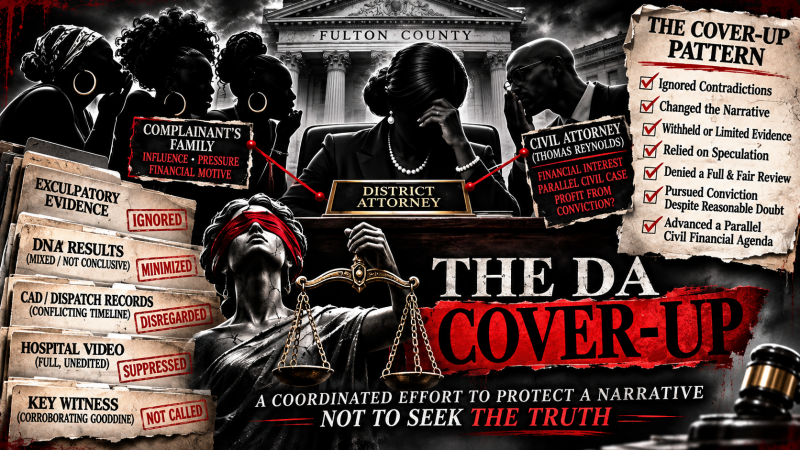
The Fulton County District Attorney's Office: When the Pursuit of a Conviction Overshadows the Pursuit of Justice
The responsibility of a prosecutor is not simply to secure a conviction. It is to pursue justice, honor constitutional protections, disclose evidence favorable to the accused, and ensure that the evidence presented to a jury is not knowingly misrepresented.
In the prosecution of Richard Gooddine, we believe the Fulton County District Attorney's Office did more than fail to adequately confront contradictory evidence. We believe its presentation of the case helped shape and reinforce a narrative that the documented evidence repeatedly called into question.
The original investigative record contained significant contradictions before the case reached trial. Authenticated police dispatch records challenged the alleged sequence of events. The reported shooting calls occurred before the alleged patrol-car ride. Witness accounts changed concerning critical details of the alleged sexual acts. Forensic testing did not independently establish that Gooddine committed those acts. Hospital security testimony also corroborated his explanation that he entered the hospital to use the restroom.
Rather than allow these conflicts to define the limits of the prosecution's case, the State advanced explanations that, in our view, minimized their significance and encouraged the jury to accept disputed interpretations as established facts.
During the 2022 trial, prosecutors suggested that Gooddine could have returned to an earlier shooting-call location despite the absence of a documented second response in the reviewed CAD records. The State's closing argument also characterized testimony concerning whether Gooddine exited his patrol vehicle in a way that did not fully reflect the complainant's earlier testimony.
The hospital evidence presents another serious concern. The prosecution emphasized conduct interpreted as intimidation, while security testimony independently confirmed that Gooddine requested and used the restroom before the confrontation with hospital personnel. The family questions whether the presentation of hospital surveillance gave jurors a complete understanding of that sequence.
These are not insignificant differences. They concern the accuracy, context, and reliability of the evidence used to persuade a jury to take away a man's freedom.
A Documented Failure to Honor Legal Protections
The concerns surrounding this prosecution extend beyond disputed interpretations of evidence.
On June 3, 2025, the Georgia Court of Appeals determined that Gooddine had been denied mandatory grand-jury protections for three criminal charges and ordered those counts dismissed.
This was a judicially established failure to follow legal safeguards designed to protect peace officers from improper indictments.
Despite the acquittals returned during the first trial and the subsequent appellate ruling, the remaining prosecution continued, ultimately resulting in Gooddine's conviction and sentence of life imprisonment plus 20 years.
More Than an Investigative Failure
The concern is not simply that prosecutors overlooked evidence. It is that the prosecution's presentation repeatedly favored interpretations supporting guilt while minimizing evidence that challenged its narrative.
We believe these decisions raise serious questions about whether the pursuit of a conviction became more important than the obligation to examine the truth.
We are calling for independent examination of the prosecution's statements to the jury, its handling of contradictory testimony, its presentation of forensic findings, its use of hospital surveillance, and its treatment of authenticated police records.
Whether those decisions resulted from serious errors, institutional bias, or knowing misconduct must be determined through a complete examination of the evidence and the officials' actions.
The power to prosecute carries an extraordinary responsibility. When that power is used without faithfully respecting the evidence and the law, the consequences can be irreversible.
Richard Gooddine lost his career, his reputation, and ultimately his freedom. We believe the evidence raises profound questions about whether those losses resulted from a fair examination of the facts or from a prosecution that became committed to defending its original narrative.
Justice is not measured by the number of convictions obtained. It is measured by whether the truth was pursued, the evidence was fairly presented, and the law was honored—even when doing so threatened the prosecution's case.
The State's obligation was to seek justice, not simply to win. We believe Richard Gooddine's case demands an independent investigation into whether that obligation was fulfilled.
A call for transparency and justice
A fair legal system relies on accountability and thoroughness. When key facts are overlooked or suppressed, an independent review is the only pathway to restorative justice and meaningful reform.

Channel 2 WSB-TV: When the Media Becomes a Weapon in the Court of Public Opinion
The Headlines Made Him Guilty in the Public Eye. But What Did the Evidence Actually Show?
Before Richard Gooddine ever stood trial, his career was over, his reputation was damaged, and his face had become associated with some of the most serious criminal allegations imaginable.
From August 2018 through his 2026 retrial, WSB-TV Channel 2 repeatedly covered allegations of sexual misconduct against Gooddine. Its reporting featured emotional interviews, serious accusations from civil attorney Thomas Reynolds, hospital surveillance footage, his termination, his arrest, and even an encounter with a reporter outside his jail cell.
We believe this coverage helped create and reinforce a presumption of guilt long before a jury had examined the evidence.
Our concern is not that Channel 2 reported serious allegations. Our concern is whether the station gave those allegations a far more powerful public platform than the evidence that challenged them.
The Headlines Versus the Evidence
1. The Three-Hour Allegation
Channel 2's original reporting, August 21, 2018:
“Girl, 15, says police officer sexually assaulted her for hours; GBI investigating.”
The original GBI investigative summary attributed an approximately 12:30 a.m. police encounter, a 1:06 a.m. departure from Sykes Park, and an approximately 2:50 a.m. return home to the complainant.
Gooddine's alibi clearly place the alleged victim in his vehicle for 15 minutes and that includes the 8 to 10 minute drive from the park.
2. The Hospital Stalking Narrative
Channel 2's 2018 reporting prominently featured allegations that Gooddine followed the family and stalked hospital hallways.
Thomas Reynolds publicly advanced this account.
But hospital security officer James Lackman described permitting Gooddine to enter after he requested the restroom. He confirmed that Gooddine used it before the later confrontation with staff.
In the 2022 trial, the prosecution itself acknowledged uncertainty about whether Gooddine had followed the family directly to the hospital.
The prosecution was also aware of a witness that could verify Gooddine's account about the reason for the visit to the hospital because he stopped at a convenient store to get a drink and he then attempted to use the restroom there before going to the hospital.
We believe that distinction should have been central to every report involving the hospital footage.
3. Earlier Allegations Presented to the Public
Channel 2 reported additional misconduct allegations against Gooddine in August 2018.
But two earlier internal-affairs investigations had concluded with findings of not sustained.
Channel 2's August 29 article did acknowledge those findings, including three passed polygraph and video evidence that investigators said did not show inappropriate conduct.
Nevertheless, we question whether the repetition and prominence of the accusations created a public impression of established misconduct despite those investigative outcomes.
FourAn allegation is not a finding of guilt. Multiple allegations do not eliminate the obligation to establish each individual offense.
4. Following Gooddine to His Jail Cell
On September 5, 2018, Channel 2 investigative reporter Mark Winne approached Gooddine inside the Fulton County Jail.
Gooddine expressly asked the reporter to leave and stated that he did not want to speak with him.
The exchange became another televised news story.
We question why this confrontation was considered necessary, what conditions permitted the camera encounter, and whether the resulting broadcast offered meaningful information beyond another highly publicized image of an accused officer behind bars.
We believe the episode reflects the extent to which Gooddine's arrest and confinement became part of the public spectacle surrounding his prosecution.
5. The CAD Records and the Missing Timeline Context
The original East Point Police Department CAD records contain an independently recorded chronology of Gooddine's police assignments.
Unit 508 was recorded at Washington Road from 12:32:54 a.m. until its 1:22:16 a.m. clearance, overlapping the complainant's reported 1:06 a.m. departure from Sykes Park.
The records also show an arrival at Thompson Avenue at 2:33:22 a.m., independently supported by another officer's testimony.
The identified shooting calls occurred earlier than the shooting-related radio transmission described in the complainant's account.
We believe a complete public account of this prosecution must examine the authenticated dispatch records alongside the accusations rather than allowing estimated witness times to stand without meaningful comparison.
6. DNA Evidence and the Impression of Forensic Proof
During the 2026 retrial, Channel 2 reported the prosecution's interpretation that Gooddine was wiping his hands at the hospital to remove biological material.
The same report acknowledged the defense's explanation that he was wiping his hands after using the restroom.
The vehicle evidence included mixed DNA samples from the steering wheel and turn-signal control. Gooddine admitting to doing a safety frisk to all four individuals that were present at the park.
Also in the 2026 trial the other alleged female at the park testified under oath that she did not witness Gooddine doing anything inappropriate. Contradicting her original account in 2018.
The earlier sexual-assault-kit did not include any of Gooddine's DNA.
The presence of skin cells, with a clear explanation on how they were deposited. Does not prove sexual assault, the areas that should have been tested for that proof was never tested by the GBI or the DA. But the DNA evidence was presented as proof of sexual assault during his 2022 in 2026 trial.
We believe the distinction between established laboratory findings and prosecutorial interpretation deserved greater emphasis.
7. The Acquittals and Appellate Ruling
In March 2022, Gooddine received seven jury acquittals, while ten counts ended in a mistrial. The court also entered two directed acquittals.
Channel 2 reported the jury's favorable verdicts, but those outcomes deserve to be understood in the context of the larger prosecution.
On June 3, 2025, the Georgia Court of Appeals determined that Gooddine had been denied mandatory grand-jury protections applicable to three charges and ordered those counts dismissed.
These were not merely defense arguments. They were actual judicial outcomes that changed the scope of the prosecution.
We believe those developments warranted prominent, sustained public attention comparable to the original allegations.
The Hospital Video and Its Influence on the Verdict
In September 2026, Channel 2 reported that a juror considered the hospital footage especially influential in reaching the guilty verdict.
The station described the jury's use of a timeline and its interpretation of Gooddine's hospital appearance.
This creates a troubling question about the importance of how evidence is presented and understood.
The video shown during trial had been condensed and manipulated. It has never been shown in its entirety the reason why it was never shown in its entirety because it is favorable to Gooddine. A production 136 ounces this week nine2026 news report even showed a manipulated video to its viewer.
We believe every second of the original footage, the security officers' testimony, the nurses' statements, and the recorded sequence of events should be examined together.
When a piece of circumstantial evidence becomes decisive in a criminal conviction, the accuracy and completeness of its interpretation become extraordinarily important.
When News Coverage Becomes a Weapon
We believe Channel 2's reporting became a powerful instrument in shaping public perception of Richard Gooddine.
From the initial allegations to the jail confrontation, from repeated interviews with complainants to the later emphasis on hospital surveillance, the public was repeatedly exposed to the prosecution's narrative.
Some favorable information was published. But we believe the central question remains whether contradictory evidence received comparable prominence, investigation, and context.
We are also concerned about the overlapping interests of civil litigation, public accusations, investigative decisions, and media coverage.
We are not asking the public to accept that every disputed broadcast was deliberately false. We are asking readers to compare the headlines against the original evidence and examine the consequences of reporting that may have created an incomplete or misleading picture.
A television station has enormous power to shape public opinion. With that power comes the responsibility to distinguish allegations from established facts, opinions from independent evidence, and courtroom arguments from judicial findings.
Our Demand for Media Accountability
We are calling for a transparent examination of Channel 2's reporting, including the original broadcasts, interviews, unedited hospital footage, court developments, and the favorable evidence available at each stage.
We want to know whether material contradictions were adequately investigated, whether important developments received proportionate coverage, and whether corrections or follow-up reports were warranted.
We believe Richard Gooddine's case raises a question extending far beyond one prosecution:
What happens when a person's reputation is destroyed in the court of public opinion before the court of law has completed its work?
A conviction does not erase the media's obligation to report accurately. An acquittal does not mean that every earlier report was false. Every stage deserves accuracy, context, and fairness.
We recognize the seriousness of sexual-assault allegations and the importance of reporting them responsibly. We also believe that public accountability requires examining information that challenges the prevailing narrative.
The media should investigate the evidence—not become an unquestioning amplifier of the accusation.
We are not asking Channel 2 to protect Richard Gooddine. We are asking it to honor the same obligation owed to every person whose life can be changed by a headline: Tell the complete, verifiable story.
Evaluate the facts yourself
Take the time to examine the official records, scrutinize the timeline, and understand the full scope of Richard Gooddine's case. Truth thrives in full daylight.